

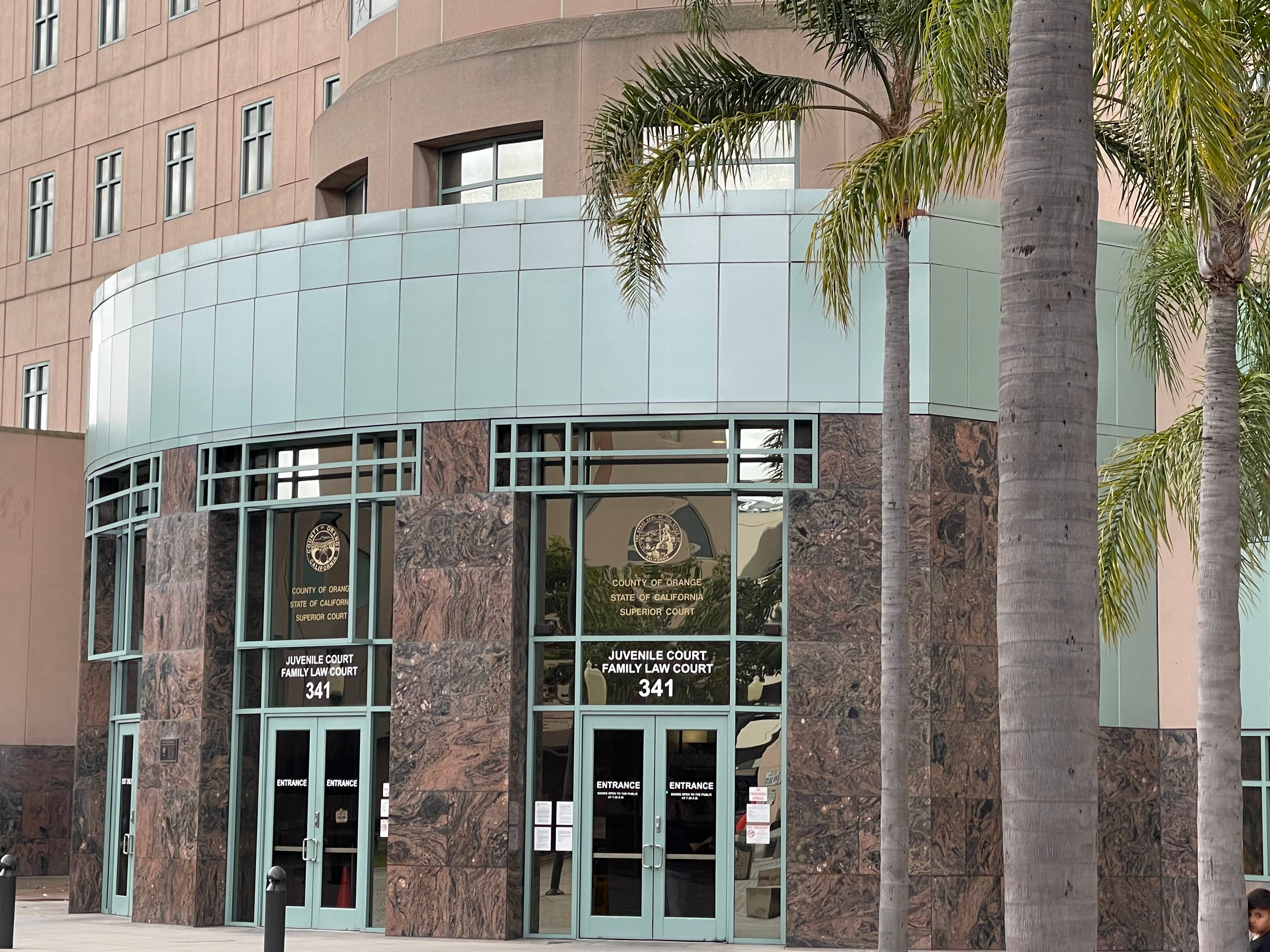
That question is no longer theoretical in Orange County.
Over the past two years, actions by multiple government entities — including the Orange County District Attorney’s Office and the Orange County Superior Court — reveal a growing pattern in which access to public records, court proceedings, and constitutional protections increasingly turns on a subjective determination of who officials deem a “legitimate” journalist.
That shift has coincided with escalating financial barriers, delayed or denied records requests, and formal challenges aimed at independent reporters covering family court operations, child safety, and the expenditure of public funds.
Who Is a Journalist Under the Law?
Under California law, journalism is defined by function — not credentials, employer, or government recognition.
Both the California Constitution and statutory law protect anyone engaged in gathering and publishing information to the public, including independent and freelance journalists. Courts have consistently held that press protections attach to the act of journalism itself, not to institutional affiliation, press badges, or editorial intermediaries.
Constitutional and Statutory Protections
California Constitution, Article I, Section 2(b)
California provides some of the strongest press protections in the nation. The state’s shield law states that:
“A publisher, editor, reporter, or other person connected with or employed upon a newspaper, magazine, or other periodical publication … shall not be adjudged in contempt … for refusing to disclose the source of information.”
The phrase “other person” is deliberate. Protection is not limited to traditional newsroom employees.
Evidence Code § 1070 (Shield Law)
This statute codifies the constitutional protection and is interpreted broadly. Courts have applied it to freelancers, independent journalists, documentary filmmakers, and digital publishers. There is no credentialing requirement and no employer requirement.
Code of Civil Procedure § 1986.1
This provision limits subpoenas directed at:
“A journalist or scholar engaged in the gathering, preparation, or dissemination of information for the public.”
Again, the emphasis is on activity, not status.
California Rule of Court 10.500
Rule 10.500 governs access to judicial administrative records and defines “news media” as:
“A person who regularly gathers, prepares, collects, photographs, records, writes, edits, reports, or publishes news or information concerning matters of public interest for dissemination to the public for a substantial portion of the person’s livelihood or for substantial financial gain.”
The rule applies to natural persons, expressly includes independent and digital journalists, distinguishes news dissemination from commercial use, and does not require press credentials or institutional recognition.
Although courts are governed by CRC 10.500 rather than the California Public Records Act, CPRA case law remains instructive. California courts have repeatedly emphasized that journalism is not a licensed profession and that government entities do not decide who “counts” as press.
Federal precedent reinforces this principle. As the U.S. Supreme Court held in Lovell v. City of Griffin (1938):
“The liberty of the press is not confined to newspapers and periodicals.”
This is not a gray area in California law.


A Pattern That Began in Court
Court correspondence shows that scrutiny of press status intensified after this reporter began submitting judicial administrative records requests independently — and more frequently — rather than through an established newsroom intermediary.
On June 11, 2024, the reporter submitted a request to the Orange County Superior Court (OCSC) Public Information Office seeking administrative records related to training requirements, qualifications, certifications, and financial-interest disclosures for court-approved professionals operating under California Rules of Court 5.225 and 5.230. The request concerned OCSC-approved lists of minors’ counsel, custody evaluators and therapists, indigent defense providers, and supervised visitation programs — policy and credentialing records, not case files.


Five days later, on June 16, the reporter submitted a second request seeking video footage from the courthouse’s sixth and seventh floors following an incident in which Deputy District Attorney Tammy Jacobs directed Orange County District Attorney’s Office investigator Joe Faria and another investigator to follow the reporter throughout the courthouse while reporting was underway.


Instead, on June 18, OCSC Public Information Officer Kostas Kalaitzidis responded that he had “taken the liberty” of researching the reporter’s personal case history previously before the court. His response asserted that covering the court while having an active case posed an “ethical hurdle” and requested communication with an editor at NewsBreak to discuss how the purported conflict might be “mitigated.”
The response cited no provision of California Rule of Court 10.500 — the governing authority — nor any legal basis for conditioning access to records on press affiliation, editorial oversight, or the absence of unrelated personal litigation.
In a written reply, the reporter clarified that the records sought were public administrative materials governed by Rule 10.500 and that any personal legal matters were unrelated. The court reiterated its demand to speak with an editor. The records were not produced.
Shortly thereafter, a colleague submitted the same requests, unchanged in scope or substance. The video footage was produced at no charge.
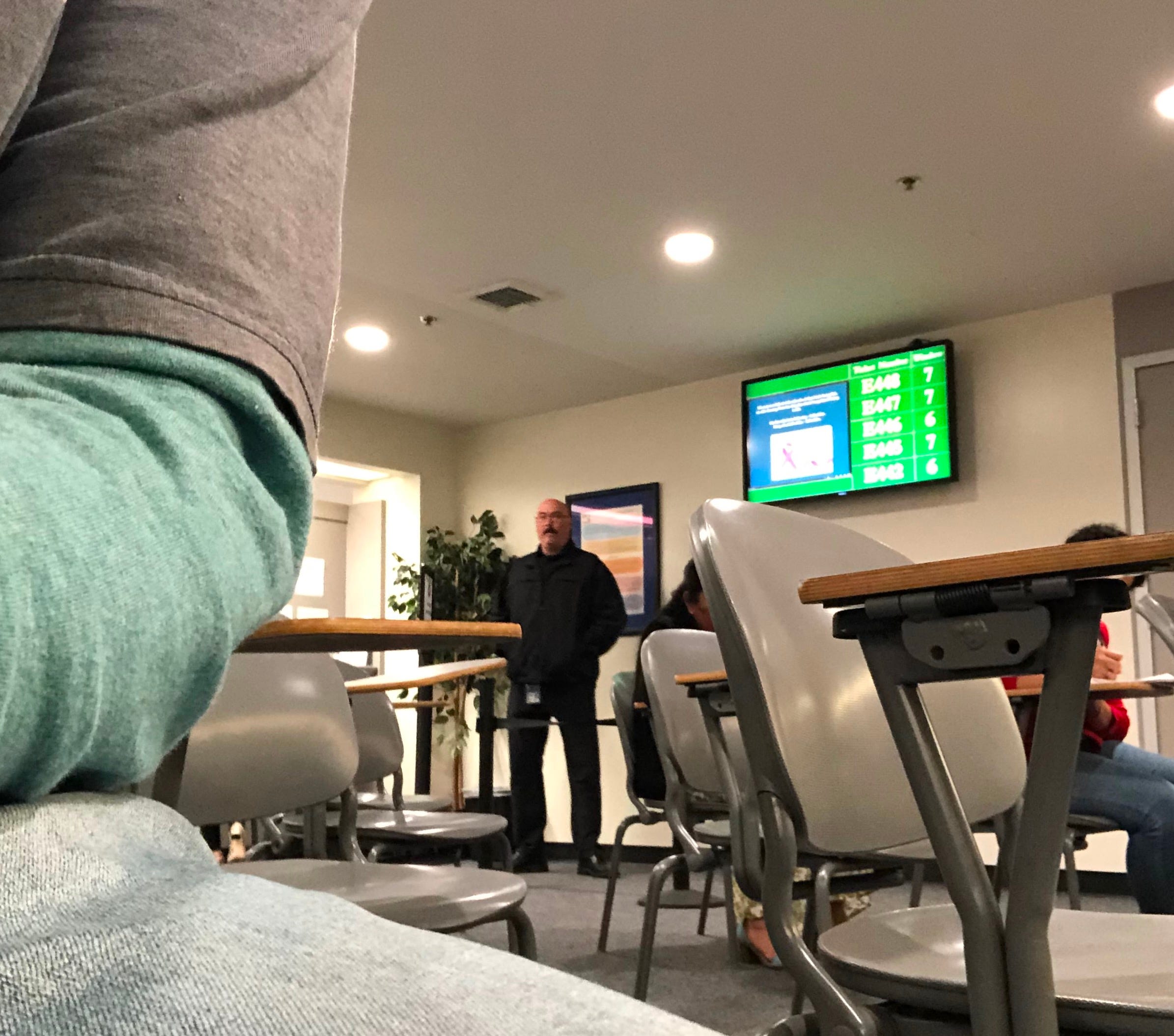
What changed was not the request — but the identity of the requester. Video from June 12 shows the sixth and seventh floors of the courthouse and the clerk’s office areas where OCDA investigator Joe Faria followed the reporter across multiple floors, entered courtroom L65, or stood observing the reporter while newsgathering was underway:
The Subpoena That Followed
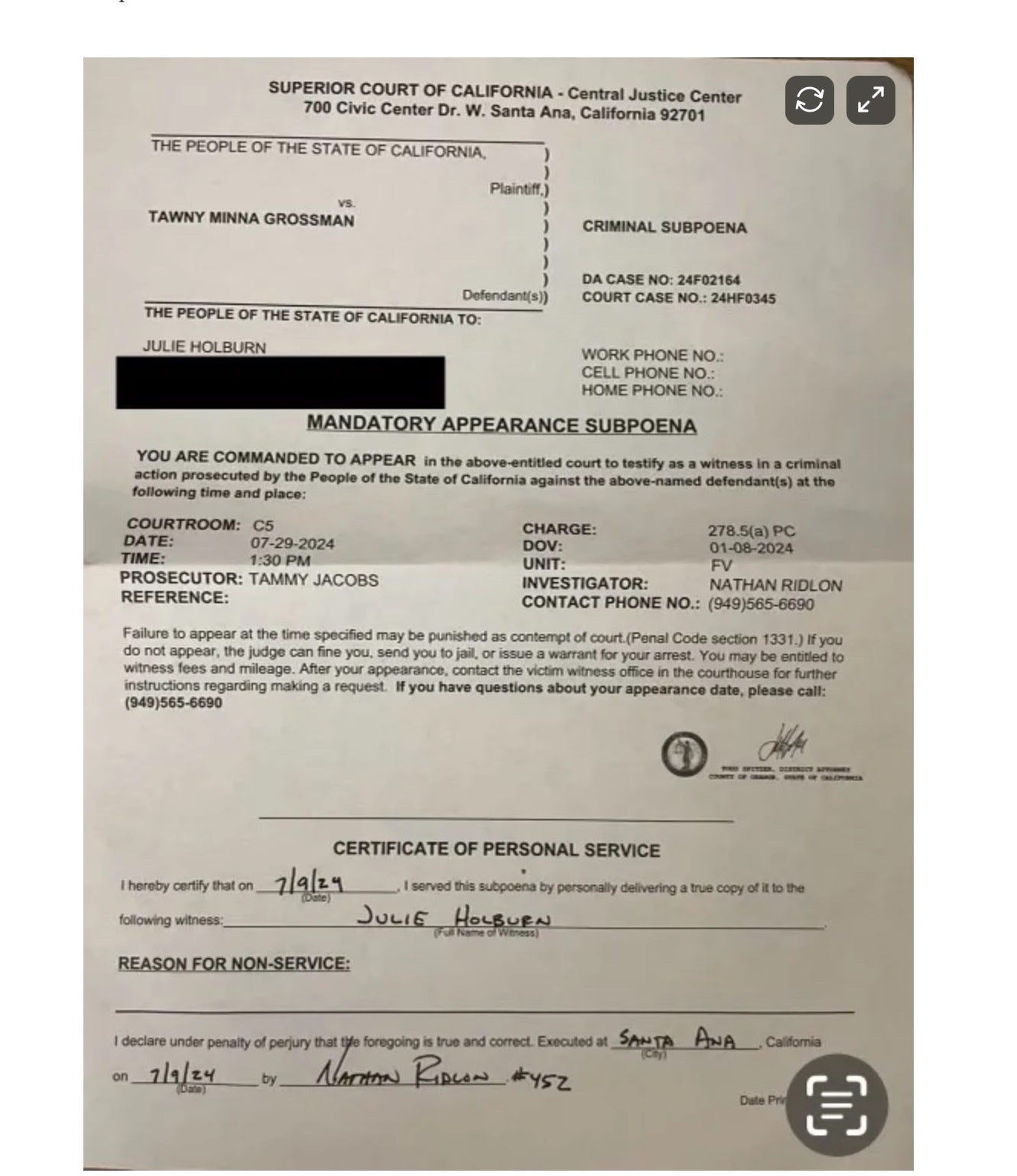
On July 9, 2024, while covering proceedings in the Tawny Minna Grossman case, the reporter was served with a subpoena issued by Orange County Deputy District Attorney Tammy Jacobs seeking testimony related to newsgathering activities.
The subpoena immediately raised constitutional concerns under California’s reporter’s shield law and longstanding First Amendment precedent.
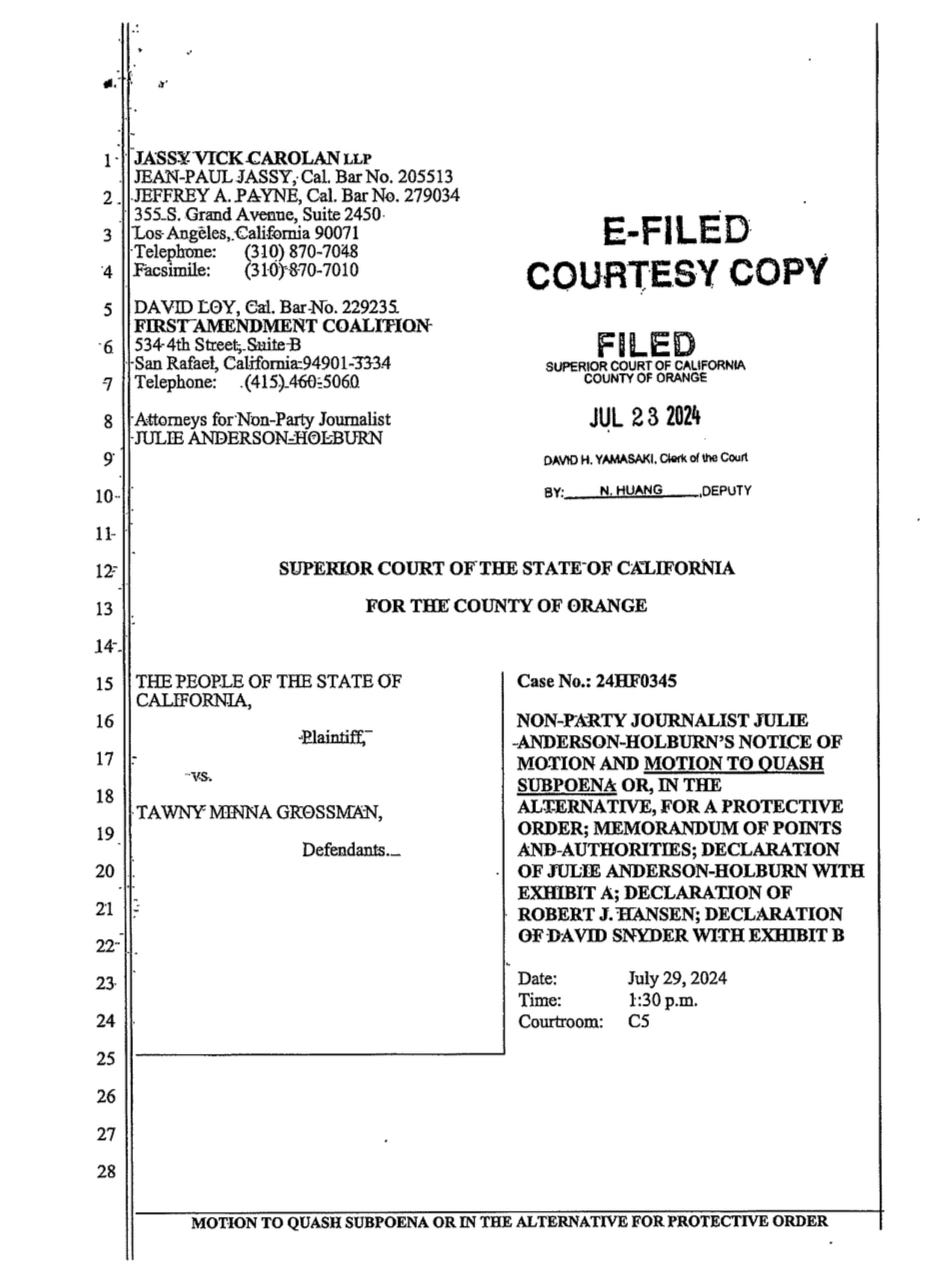
The First Amendment Coalition, joined by Jassy Vick Carolan LLP, filed a 70-page motion to quash. After review by county counsel, DDA Jacobs formally withdrew the subpoena on the record. First Amendment Coalition Executive Director David Loy appeared in court to defend the reporter’s rights, and the motion remains part of the official Tawny Minna Grossman case file.
The outcome reaffirmed a core principle: constitutional protections attach to journalism itself, not institutional affiliation.


From Subpoenas to Financial Barriers
In the months that followed, access barriers shifted from questioning the reporter’s status to imposing costs. Multiple judicial administrative records requests, spanning more than a year, remained unanswered by the Orange County Superior Court.
In April 2025, court counsel John McCoy demanded $4,240 to produce a single report containing judicial administrative data governed by California Rule of Court 10.500. The request had been pending for nearly 10 months, despite the court maintaining the information electronically.
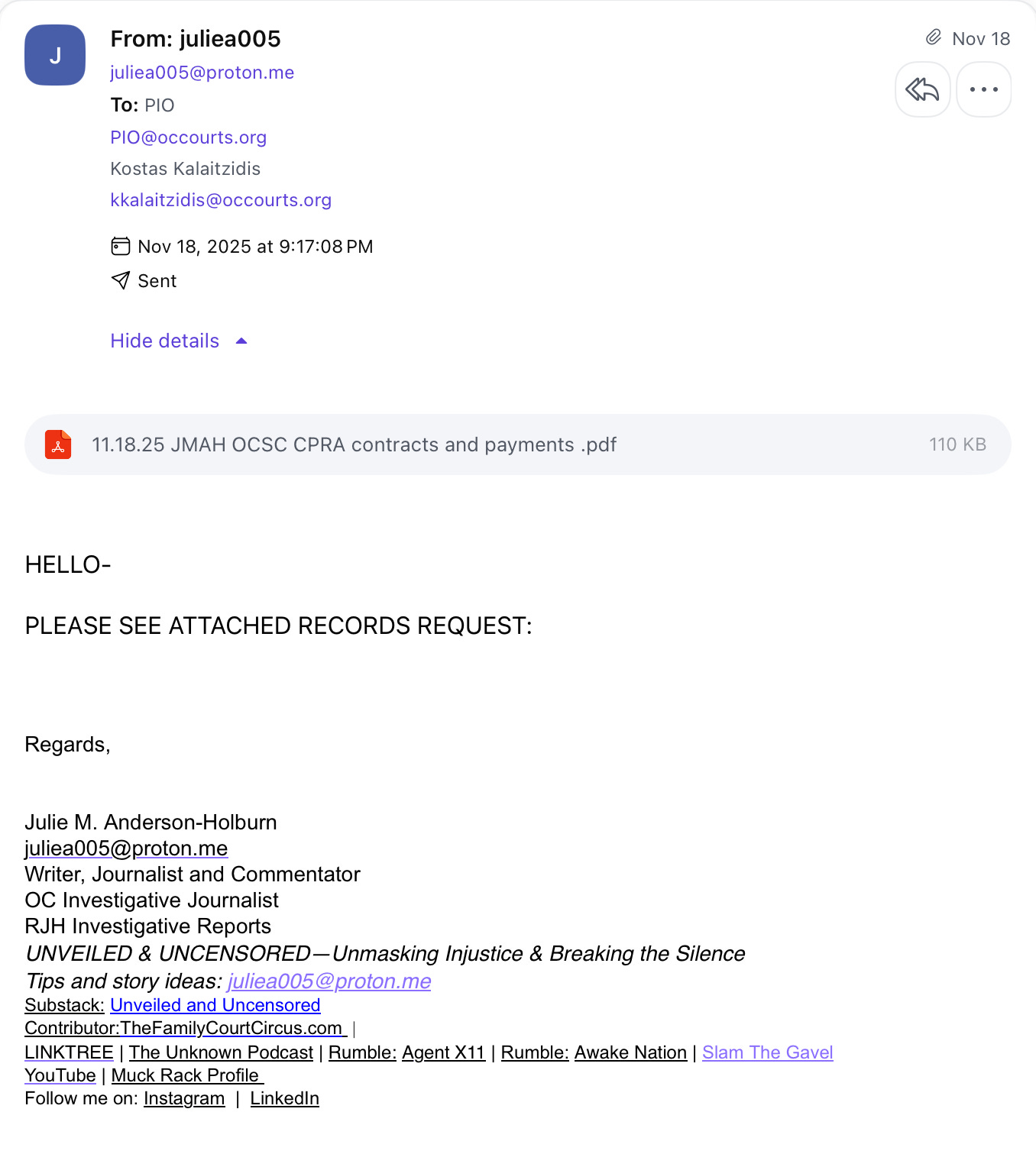
On Nov. 18, the reporter submitted a new records request seeking public contracts and payment records involving minors’ counsel Brian Baron and the Law Offices of Harold LaFlamme.
In court communications dated Dec. 3, officials asserted that the extraordinary fees were tied, at least in part, to the court’s position that the requester was “not recognized as a real reporter,” while also acknowledging that OCSC’s criteria for determining who qualifies as media were outdated.
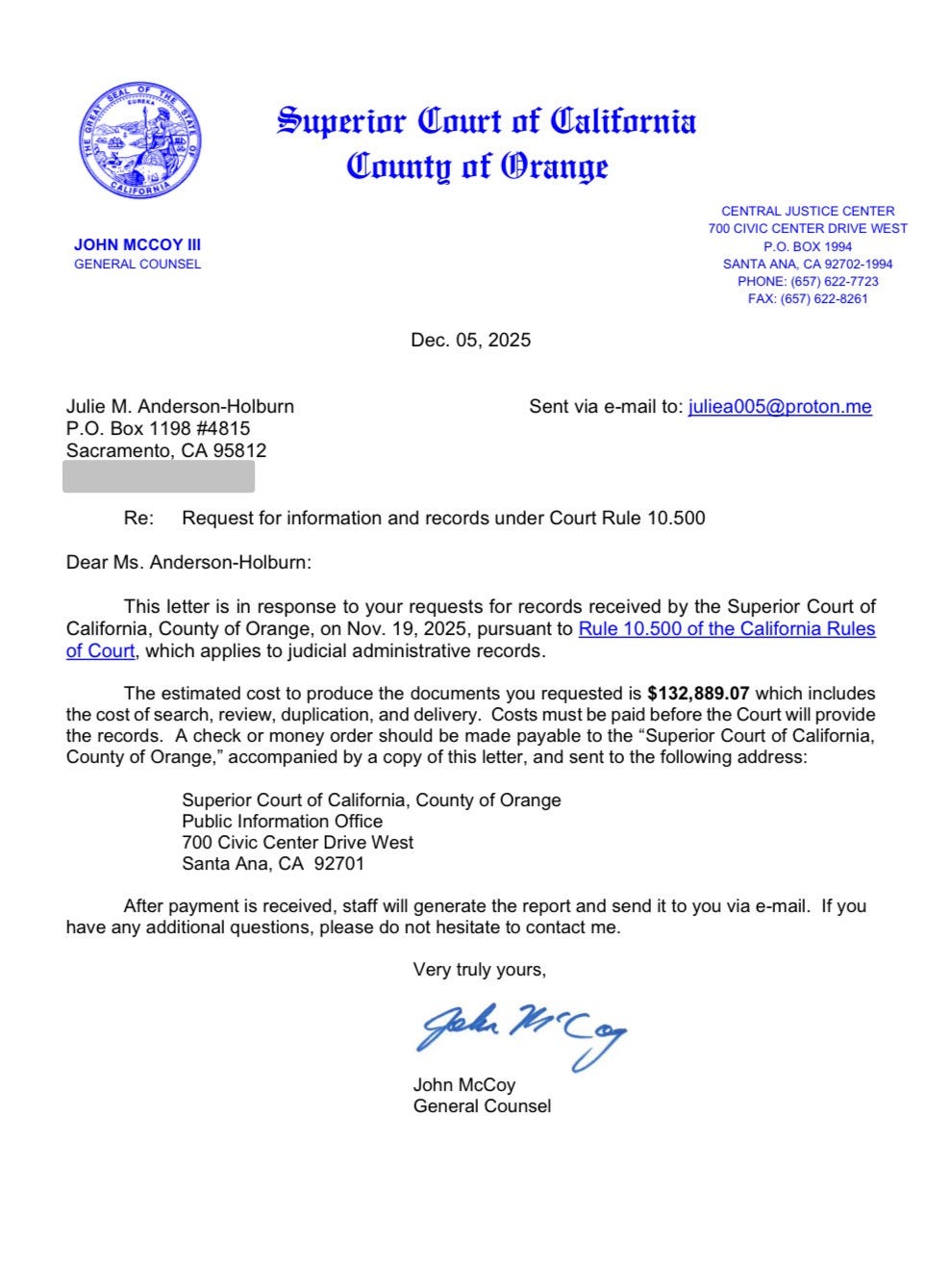
On Dec. 4, the OCSC escalated further, demanding $132,889.07 to produce contracts and payment records involving Baron and the LaFlamme firm. These records fall squarely within Rule 10.500, which limits courts to recovery of the direct cost of duplication and expressly distinguishes news dissemination from commercial requests.
On Dec. 5, the reporter formally objected, requesting an itemized breakdown of lawful duplication costs, identification of any records withheld, and confirmation that the records are maintained electronically.


On Dec. 12, McCoy asserted that the request was now “overly broad” and that responsive records would need to be “created,” triggering cost recovery — despite the request being narrowly limited to existing contracts and payment records involving the two named vendors.
The Spitzer Encounter
That institutional posture surfaced publicly the previous day.
While exiting the Orange County Board of Supervisors building on Dec. 11, the reporter encountered District Attorney Todd Spitzer in an open public quad. He was accompanied by two others, including a police officer. During the exchange, Spitzer referred to the reporter as a “self-designated” journalist, asked to see “press credentials,” and stated that he “sees all” of the reporter’s work.
A nearby officer noted that press credentials primarily function as security access tools and are not a measure of journalistic legitimacy.
Why the Question Matters
Who qualifies as a journalist — and who gets to decide — has a clear answer under the law.
Neither the First Amendment nor California law authorizes public officials to condition access, recognition, or constitutional protection on credentials, employer affiliation, or institutional approval.
Rule 10.500 is expressly intended to expand public access. It requires courts to broadly construe access rights, assist requesters, and avoid unnecessary delay or obstruction. It does not distinguish between journalists and members of the public — let alone permit courts to deny access because they “do not recognize” someone as media.
When an elected district attorney publicly questions press status following a withdrawn subpoena and amid disputed access to court records, the significance lies not in the exchange itself, but in what it signals institutionally.
A Pattern, Not an Isolated Comment
Viewed together, the record reflects a consistent progression:
An attempted subpoena later withdrawn after constitutional challenge
Judicial administrative records delayed or denied
Escalating fee demands exceeding $136,000
Assertions that independent journalists are “not reporters”
A public inquiry by the county’s top prosecutor into press credentials
Taken collectively, these actions raise fundamental questions about how access is regulated — and who decides.
The Records at Issue
The requested records concern millions of dollars in public funds and the operation of family courts.
Judicial Council data show that contracts and payments involving Brian Baron and the Law Offices of Harold LaFlamme exceed $28 million, with payments continuing after LaFlamme’s death and Baron now operating the entity.
Access to these records allows journalists and the public to examine whether patterns exist in court appointments, expenditures, and outcomes — a core function of transparency.
Pricing access beyond reach raises serious concerns under Rule 10.500 and the First Amendment.
Transparency Is Not Optional
The Constitution does not distinguish between “approved” and “self-designated” reporters. It protects journalism.
Whether independent journalists are permitted meaningful access to judicial administrative records may determine not only how family courts are scrutinized — but whether transparency itself remains accessible to the public.
Sunlight, as ever, remains the safeguard.
Editorial Note:
This article is supported by contemporaneous emails, court correspondence, subpoena records, and written fee determinations issued by the Orange County Superior Court. Source documents will be published alongside this piece.
This ongoing series on the OC family court crisis and nationwide family court crisis aims to bring national attention to these systemic issues, advocating for immediate reform and accountability. The time for action is now. It is imperative that lawmakers, the media, and the public unite to demand justice and protection for all families involved.
Are you committed to protecting America’s children and restoring integrity to our legal system?
Contact your legislative representatives. Speak out. Reach out to media outlets. And vote. Find your state and federal legislative representatives HERE.
Whistleblowers and victims of family court, CPS, probate court, IDEA/ADA or foster care corruption anywhere in the U.S.—please contact this reporter at juliea005@proton.me or rjh.investigative.reports@gmail.com.
Together, we can ignite a national movement and create lasting change.
Julie M. Anderson-Holburn is a California-based investigative journalist reporting on criminal and family court corruption, judicial abuse, domestic violence, child abuse and systemic failures. Her work is published on NewsBreak, Substack, and The Family Court Circus, and has been featured by the Center for Judicial Excellence and National Safe Parents. Julie believes that exposing the truth is the first step toward meaningful reform.
This article was made possible by the support of readers like you. Thank you.
Related coverage from California and Arizona:
FOR IMMEDIATE RELEASE — Rally and Court Watchers Requested for Nov. 7 in Orange County, Calif.
FOR IMMEDIATE RELEASE—COURT WATCHERS REQUESTED FOR OCT. 20 GISELLE SMIEL CASE IN LOS ANGELES
Orange County DA’s Office: Jury Awards $3M Over Culture of Malice and Retaliation Against Women
Leanne fled the country to escape domestic abuse. Now she could face jail.
The Victims of Jessica St. Clair, Parents and Children Share Their Trauma, Part Two
Whistleblowers Reveal Corruption in Orange County Family Courts and Beyond
Orange County DA’s Office Hostile to Women: Unprotected OC Women Suffer Under Spitzer’s Retaliation
Orange County Protest to Spotlight Family, Probate and Juvenile Court Failures, Sept. 17
Orange County Parents Speak Out Against Family Court and CPS in Nationwide Protest
Retaliation in Hackensack: Dr. Bandy X. Lee, Bruce Fein Confront Family Court Over First Amendment
Arizona’s Final Committee Hearing on Family Court Failures and the National Reform It Demands
Octo-Mom’s Former Attorney Sued: Client Alleges Collusion and Rigged Custody Case
Exclusive: OC Custody Evaluator Under Investigation After Molestation Case; BBS Ignored Complaints
Exclusive: Unveiling the legal battle in Orange County that no one else dares to report
I was a court-appointed counsel for the elderly and mentally challenged. DC is different, they really care about the wards. But it too often was a struggle against the court system to get paid, questioning decisions with the threat of sanctions because the family was upset at the facility they were in, but most if all, we were only paid once a year and our fee petitions were chopped to pieces. There has to be support for honest actors.
I would like to publish my story of my friend's court case: Collusion, conspiracy, bribery, children torn away. He is terrified they will come after him again. He has hard evidence...even of the wife and her lawyer conspiring to drug his food for a drug test....tons of unreal evidence. I condensed his many many pages to 32 pages......I feel my hands are tied.